Can you tell us about your academic background in STEM?
I am a microbiologist driven by the belief that every woman giving birth deserves the right to see her child live, and that every child deserves the right to live a healthy life from birth.
I completed my PhD in Pharmaceutics (Pharmaceutical Microbiology) at the University of KwaZulu-Natal (UKZN), South Africa in 2018. My doctoral research provided instrumental knowledge to improve food safety in Cameroon and South Africa, as evidenced by my 12 first-author PhD peer-reviewed publications. I also set a precedent on the momentum of work on antimicrobial resistance in the food chain in both Cameroon and South Africa with the first detection of livestock-associated methicillin-resistant Staphylococcus aureus (LA-MRSA) in Cameroon and in pigs in South Africa.
Currently, my research focuses on the epidemiology, transmission, and evolution of antibiotic-resistant bacteria, particularly in mothers and neonates in Cameroon and across Africa. I supervised and mentored 10 MSc students in clinical biology as well as 04 junior staffs in Cameroon and helped them to develop their research skills and progress in their career. I am currently lead and co-supervisor of two PhD students at the University of KwaZulu-Natal, South Africa.
I have secured multiple grants aimed at enhancing maternal and neonatal health in Cameroon. I won Cambridge Africa Alborada Scheme (2019), RSHTM Small Grant (2021), Thrasher Early Career Award (2021). I won back-to-back OWSD Early Career Women Fellowship and AREF Research Development Fellowship in 2022. And, more recently I secured the prestigious Marie Sklodowska-Curie Postdoctoral Fellowship European Union H2020, where I am developing a rapid, point-of-need diagnostic tool for maternal and neonatal infections to be implemented in resources constrained-settings. As a testimony to my work, I was appointed as Honorary Lecturer at the School of Medicine at the University of St Andrews (2024) and Honorary Senior Lecturer at the University of KwaZulu-Natal (2023). I served and continues to serve both at the national and international levels and currently on the advisory panel on the WHO Foodborne Disease Epidemiology Reference Group (2021-2025) reflecting my influence on academia, research, and policy globally.
What motivated you to pursue a career in this field?
Since my childhood, I have always wanted to save lives. I knew from college that I would be a medical doctor. I landed in biomedical sciences because I was rejected from all national entrance exams to medical school. I did not know what this field meant at the time, but I have slowly fully grasped its power, and I never regretted being a biologist.
Besides being a biologist, I’m a microbiologist, meaning I studied microbes, these germs that are present in our environment, can help, protect and threaten us, but are invisible to us.
My focus on antimicrobial resistance was linked to my master’s internship, where I saw firsthand how many patients had infections caused by bacteria, notably Staphylococcus aureus and Escherichia coli, that were able to survive despite the action of antibiotics we put in their contact in the lab. This sparks my curiosity, and because it was so common, I decided to pursue this field. Today, antimicrobial resistance is one of the greatest issues, not just a public health issue, that the world is facing because it affects all areas of life and requires multidimensional efforts.
The consequences of antimicrobial resistance is worse for vulnerable population especially pregnant women and neonates. During my second pregnancy, I experienced firsthand the stark realities of maternal health in Cameroon. I witnessed the tragic loss of families whose babies either died during delivery or shortly thereafter. Two of my classmates, both healthcare professionals and pregnant at the same time as me, tragically lost their children during labour or in the first week after birth. One of them nearly lost her life. I grappled with an existential crisis, questioning why I was among the few fortunate enough to have a healthy child while others faced such profound loss. This injustice fueled my resolve to ensure that my children would not grow up in a world where having a healthy child seemed like a privilege.
This experience inspired a pivotal shift in my research focus. I moved away from food safety, where I had been highly productive for five years, including during my PhD, to concentrate on maternal, newborn, and child health. Since then, I have secured significant funding to realize my vision of creating a better world for my children.
What challenges have you faced as a woman in STEM and how have you overcome them?
Professionally, the most difficult challenge I have encountered in my work is certainly the lack of funding to run high-quality research and the scarcity of qualified human resources. These challenges urged me to strategically plan my funding strategy and align it to my research vision so that I can continue to deliver on time, accurate and high-quality data. I then have secured multiple grants aimed at enhancing maternal and neonatal health in Cameroon, notably the Cambridge Africa Alborada Scheme (2019), the Thrasher Early Career Award (2021) and the OWSD Early Career Women Fellowship (2022). Owing to these grants, I have established my research unit within the CEDBCAM-RI (www.cedbcam.com) in Yaoundé, Cameroon and am pioneering transmission dynamics study of antimicrobial resistance in mothers and neonates in the country.
To address the challenges of human resources, I learnt that an individual with strong motivation, striving for change and learning fast could do the job as a qualified human resources if well trained and managed. From 2018 to date, I have thus supervised and mentored 10 MSc students in clinical biology as well as 04 junior staff in Cameroon. I am currently a lead and co-supervisor of a PhD student at the University of Noguchi, one Master student at the University of KwaZulu-Natal, South Africa and five Master students in Cameroon. Today, seven Master students I supervised or co-supervised published in high-impact-factor journals like One Health, Antimicrobial Resistance and Infection Control, Pathogens, among others.
Personally, the principal challenge I have experienced was balancing my family and my career. Though today, I don’t believe that there is a moment we are fully balanced, only seasons of focus but accepting that was and still is a daily challenge. Navigating this journey has been made much easier thanks to my support system: my husband, who is also in full-time researchers, my family, friends, mentors, and collaborators. They have helped me navigate this path with confidence.
In Africa, it’s often easier to raise children due to stronger family support systems. In Europe, however, it requires patience and self-care as family is not always nearby, and financial constraints can pose challenges. I find myself scheduling my children’s activities in my calendar just like meetings, striving to attend their school functions and weekend events. Being a mother in STEM sometimes means turning down invitations to conferences because childcare isn’t available or working late at night while the rest of the family sleeps. My children may be too young to fully articulate it, but I know they sense the sacrifices involved in raising them; their love and support reflect that understanding.
Some of my decisions, like launching a YouTube channel, were inspired by discussions with my youngest child, who was just four at the time. It reminds me that everything I do is part of a legacy I am creating for my children and future generations.
Being a mother in STEM has become my superpower. I strive to be a superhero for my kids, and I believe all women, especially those in STEM, are superheroes who should never settle for less than they deserve.
What are the most exciting developments or projects in your field at the moment?
The most exciting thing I did recently was the development of an integrated and innovative solution for rapid microbiota analysis and predictive diagnosis of maternal and neonatal infections as part of a Marie-Curie Postdoctoral Fellowship. It is a super-fast bacterial solution capable of identifying infections and potential antibiotic resistance in 15 minutes at the patient’s bedside. I have successfully developed a prototype solution that is currently being validated on stored vaginal clinical samples for the first version, with a turnaround time of less than 20 min. Ultimately, my goal is to accelerate progress in neonatal health as my dream is to see fewer babies lost to sepsis, smarter use of antibiotics, and a stronger scientific foundation in Cameroon.
I’m also working on two innovative solutions for detection of outbreaks in neonatal units in Cameroon and a rapid diagnostic method with low-cost equipment.
As the saying goes, « prevention is better than cure« , but when the disease occurs, we do need to have a rapid, reliable, state-of-the-art, and easy-to-use solution produced locally to save babies and save our future generations.
How do you see the future of STEM? : What are your predictions for the areas that will see significant?
AI is changing the game in all fields across the world. The same is true for STEM.
Researchers need to integrate, adapt and learn how to master AI so that our solutions and interventions are more accurate, faster and better for all. We also need ethics to know where are the limit and educate next-generation about the pros and cons of using AI.
I also see that Africa will wake up to lead the game in STEM fields and become a source of global excellence.
What advice would you give to a young girl considering a career in STEM?
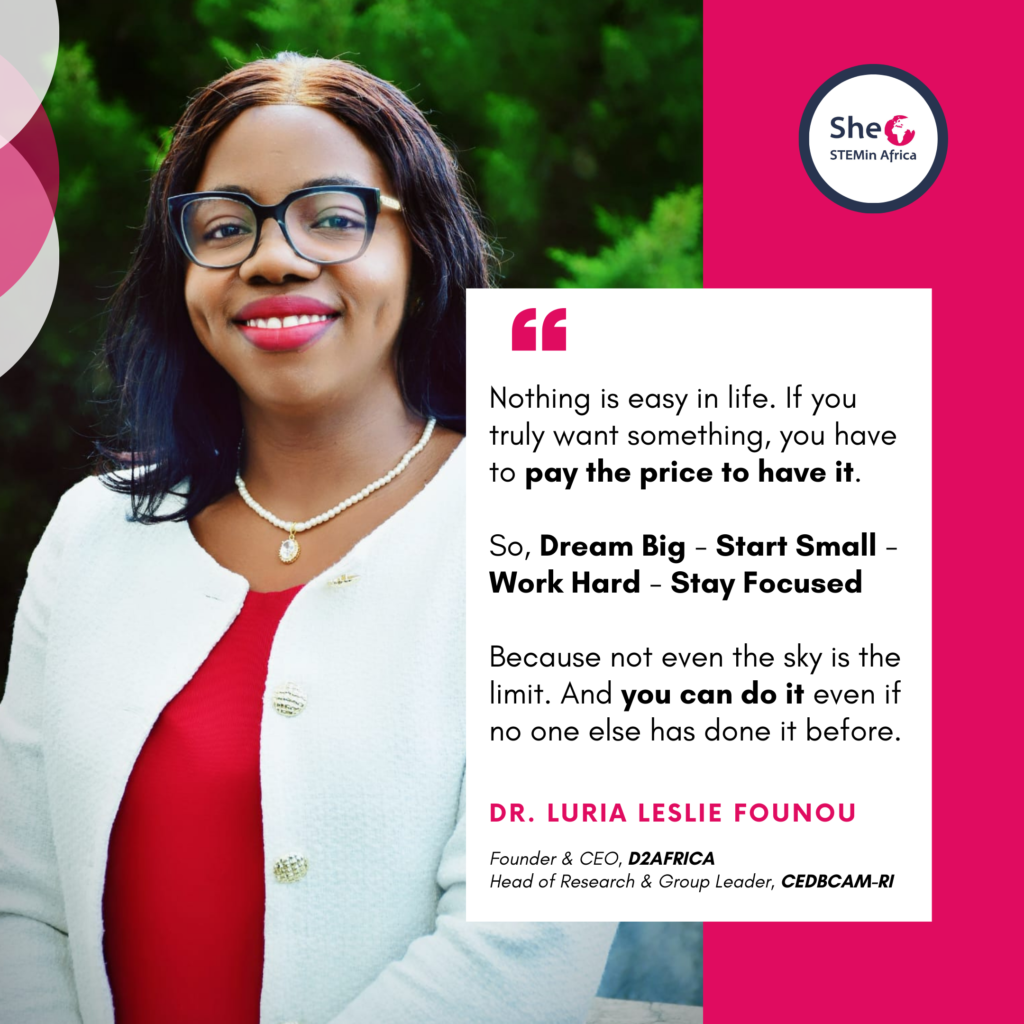
Nothing is easy in life. If you truly want something, you have to pay the price to have it.
So, Dream Big – Start Small – Work Hard – Stay Focused
Because not even the sky is the limit. And you can do it even if no one else has done it before.
Vous souhaitez être mis en avant comme Dr. Founou, rejoignez-nous en cliquant sur le bouton ?
Pour rejoindre notre communauté WhatsApp de plus de 250 filles et femmes scientifiques, cliquez ici.
Comment adhérer à notre association ?
– En ligne en cliquant ici
– Par Mobile Money chez notre Vice Présidente au +237 94896484
Si vous souhaitez faire un don pour soutenir notre travail, nous serions ravis de vous compter parmi nos précieux donateurs.
#InspiringAfricanWomenScientists #CameroonianWomenInSTEM #WomenInSTEM #STEM #WomenInScience #ScienceAfricaine #LeadershipFéminin #Innovation #SantéMaternelle #SantéNéonatale #Inspiration #Recherche #CambridgeAfricaAlboradaScheme, #ThrasherEarlyCareerAward #OWSDEarlyCareerWomenFellowship #MarieSklodowskaCurie #PostdoctoralFellowship #EuropeanUnion #H2020
Publié par Dr. Pulchérie Matsodoum Nguemté
Fondatrice de She STEMin Africa