
Can you tell us about your academic background in STEM?
I started with a strong foundation in mathematics and physical sciences during secondary school, which led me to earn a Baccalaureate C with a focus on these subjects.
Based on my excellent academic results, I later received a scholarship from the Beninese government. Then, I pursued a bachelor’s degree in agronomy, where I graduated as the top student of my cohort.
During my studies, I discovered the growing importance of data analysis, which led me to pivot toward biostatistics. I later completed a Master’s degree in Biostatistics, focusing on applying data science and AI to real-world challenges in agriculture and health.
What motivated you to pursue a career in this field?
What motivated me most was seeing how data and AI can solve concrete problems around me. During an internship, I noticed how many people struggled with data analysis and how much impact these skills could have, especially in agriculture and public health. I realized I wanted to work at the intersection of science, data, and social impact, where technology directly improves people’s lives.
What challenges have you faced as a woman in STEM and how have you overcome them?
One of the main challenges has been self-doubt, which I later understood as imposter syndrome, something many women in STEM experience. I overcame it by focusing on continuous learning, surrounding myself with supportive communities, and learning to speak about my work with confidence. Sharing my journey and mentoring other women has also helped me grow and feel more legitimate in this space.
That’s why I am currently working on « Be Proud & Shine« , an initiative dedicated to leadership and professional development. Through a 30-day community challenge and a structured academy, we support women in overcoming impostor syndrome, building confidence, strengthening their online presence, and asserting their skills in tech and innovation.
What are the most exciting developments or projects in your field at the moment?
I’m particularly excited about the use of AI for climate prediction, agriculture, and health in African contexts. My recent work on using deep learning models to optimize cropping calendars for farmers is a good example of this potential. I’m also very inspired by projects that make AI more inclusive, such as local language technologies and AI-driven tools for mental health support.
How do you see the future of STEM? : What are your predictions for the areas that will see significant?
I see the future of STEM as deeply interdisciplinary and impact-driven. Areas like AI for climate resilience, health, agriculture, and social good will grow significantly. The main challenges will be data quality, ethical use of technology, and ensuring that innovations are adapted to local realities rather than copied from elsewhere.
What advice would you give to a young girl considering a career in STEM?
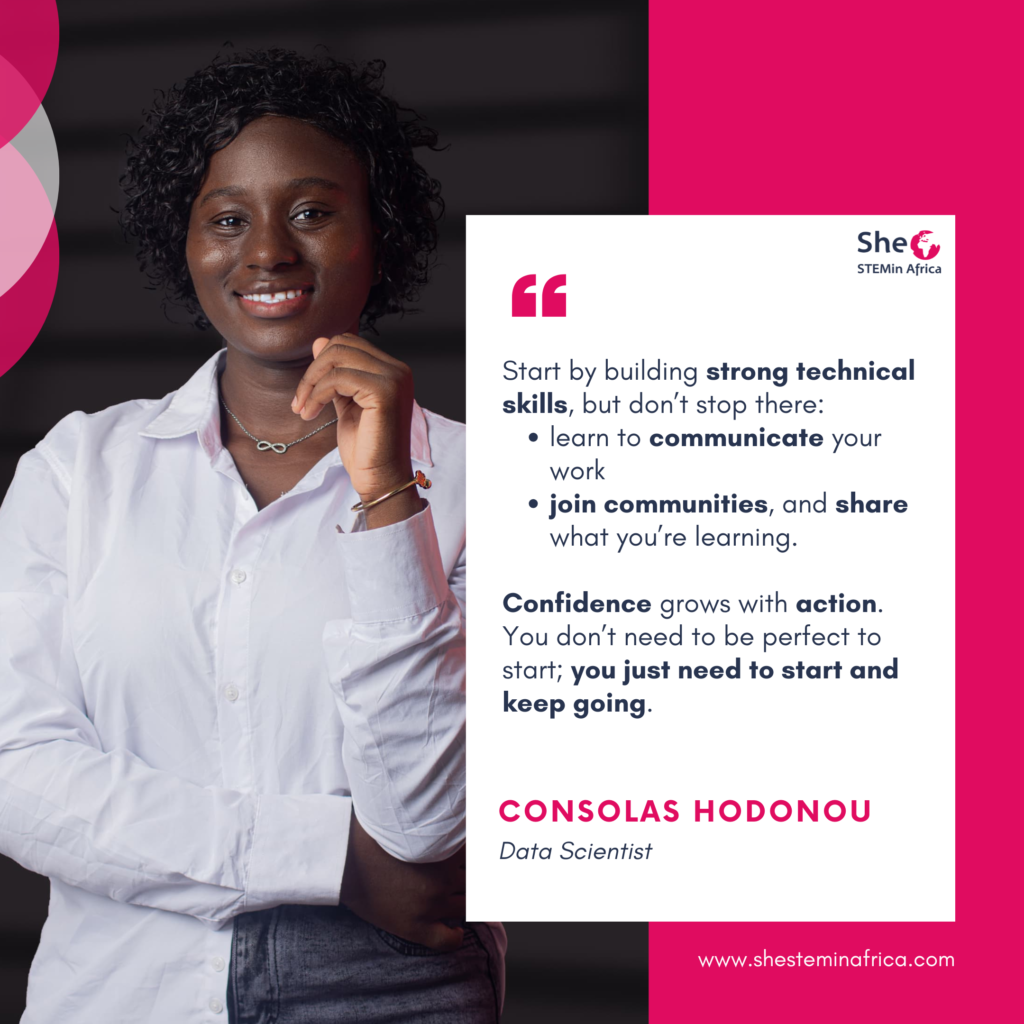
I would tell her that :
- she belongs there.
- Start by building strong technical skills, but don’t stop there: learn to communicate your work, join communities, and share what you’re learning.
- Confidence grows with action. You don’t need to be perfect to start; you just need to start and keep going.
Vous souhaitez être mis en avant comme Consolas, rejoignez-nous en cliquant sur le bouton ?
Pour rejoindre notre communauté WhatsApp de plus de 250 filles et femmes scientifiques, cliquez ici.
Comment adhérer à notre association ?
– En ligne en cliquant ici
– Par Mobile Money chez notre Vice Présidente au +237 94896484
Si vous souhaitez faire un don pour soutenir notre travail, nous serions ravis de vous compter parmi nos précieux donateurs.
#InspiringAfricanWomenScientists #WomenInSTEM #STEM #ScienceAfricaine #LeadershipFéminin #SheStemInAfrica #FemmesEnSTEM #AfriqueInnovante #DataScience #IntelligenceArtificielle #AgricultureAfrique #BeProudAndShine #Inspiration
Publié par Dr. Pulchérie Matsodoum Nguemté
Fondatrice de She STEMin Africa