Could you tell us about your academic background in STEM?
After completing my secondary school studies, my strong performance in science subjects made it evident that I would pursue a scientific path. When I reached high school and served as the Senior Prefect Girls, I honestly never expected science to be as tough as I experienced, though biology was always a breeze for me.
My university journey was a period of unplanned exploration; I moved from one department to another, spending my first year in Environmental Science and my second year restarting in Microbiology, yet I felt like neither field was the right fit. In my third year, I wrote the entrance examination for Midwifery at the University of Buea and passed, which is where my actual university journey truly began.
I fell in love with the science of human reproduction, the intricate biological processes of fetal development, and the technical precision required to safeguard both mother and child.
What motivated you to pursue a career in this field?
My motivation to pursue a career in Midwifery was rooted in a desire to find a career where science meets deep human impact.
After exploring Environmental Science and Microbiology, I realized I didn’t just want to study life in a lab or through a microscope; I wanted to be at the very forefront of where life begins.
Transitioning to Midwifery allowed me to channel my natural love for biology into something tangible—empowering women and ensuring the safety of mothers and their newborns during their most vulnerable and powerful moments.
I was driven by the challenge of the clinical rigor and the profound responsibility of bringing new life into the world, finally finding the « science » that felt like home.
What challenges have you faced as a woman in STEM, and how have you overcome them?
As a woman in STEM, one of the greatest challenges I faced early on was the lack of professional guidance and the feeling of isolation, which almost led me to drop out of the profession entirely.
In a field like Midwifery, which lacks the same institutional support as more traditional sciences, finding a clear career path can be incredibly difficult. To overcome this, I leaned into the power of mentorship and community. I actively sought out networks like the International Confederation of Midwives’ Young Midwife Leader program (I applied for and got selected), which provided me with the orientation I had been missing.
Today, I am transforming those past challenges into direct action; to date, I have mentored over 205 student midwives—both directly and indirectly—ensuring they have access to the role models and professional clarity that I once lacked. By creating platforms like Marthie’s Midwifery Diary (my facebook blog) and founding my own organization- For Mom and Baby Foundation, I’ve learned that the best way to overcome systemic barriers is to build the support structures that were once missing for us.
What are the most exciting developments or the most interesting projects in your field at the moment?
In the current landscape of midwifery, the most exciting developments involve the intersection of high-tech innovation and grassroots advocacy. We are seeing a major shift toward Digital Midwifery, where artificial intelligence and machine learning are being used to formalize « tacit knowledge »—the intuitive, experience-based skills midwives use—to standardize high-quality care and predict complications before they become emergencies.
On a global scale, projects like the ICM ‘One Million More Midwives’ campaign and the 2026 Midwifery Leadership Journey are empowering us to move beyond clinical roles and into decision-making spaces where we can influence national health policies. Closer to home, through the For Mom and Baby Foundation, I am particularly energized by our work in conflict-affected regions of Cameroon. We are leveraging digital platforms to provide life-saving health education and building ‘hub-and-spoke’ models that ensure even the most remote communities have access to respectful, midwife-led care.
How do you see the future of STEM? : What are your predictions regarding the areas that will see significant growth, and what challenges will need to be addressed?
The future of STEM is shifting from isolated discovery to a highly integrated, interdisciplinary ecosystem where the silos between science and service are finally breaking down.
I predict significant growth in convergent sciences, such as Computational Biology, Green Engineering, and AI-driven Healthcare—specifically Digital Midwifery, where predictive analytics and wearable tech will become standard tools for improving maternal outcomes.
However, the primary challenge we must overcome is the STEM skills gap and administrative lag; we need to move beyond traditional definitions to ensure that clinical professions like midwifery are officially recognized and funded as STEM disciplines. Furthermore, as AI automates routine tasks, the future of STEM will increasingly rely on human-centered technical skills—empathy, ethical decision-making, and cross-cultural communication—to ensure that technological advancements actually reach and serve the world’s most vulnerable populations.
What advice would you give to a young girl considering a career in STEM?
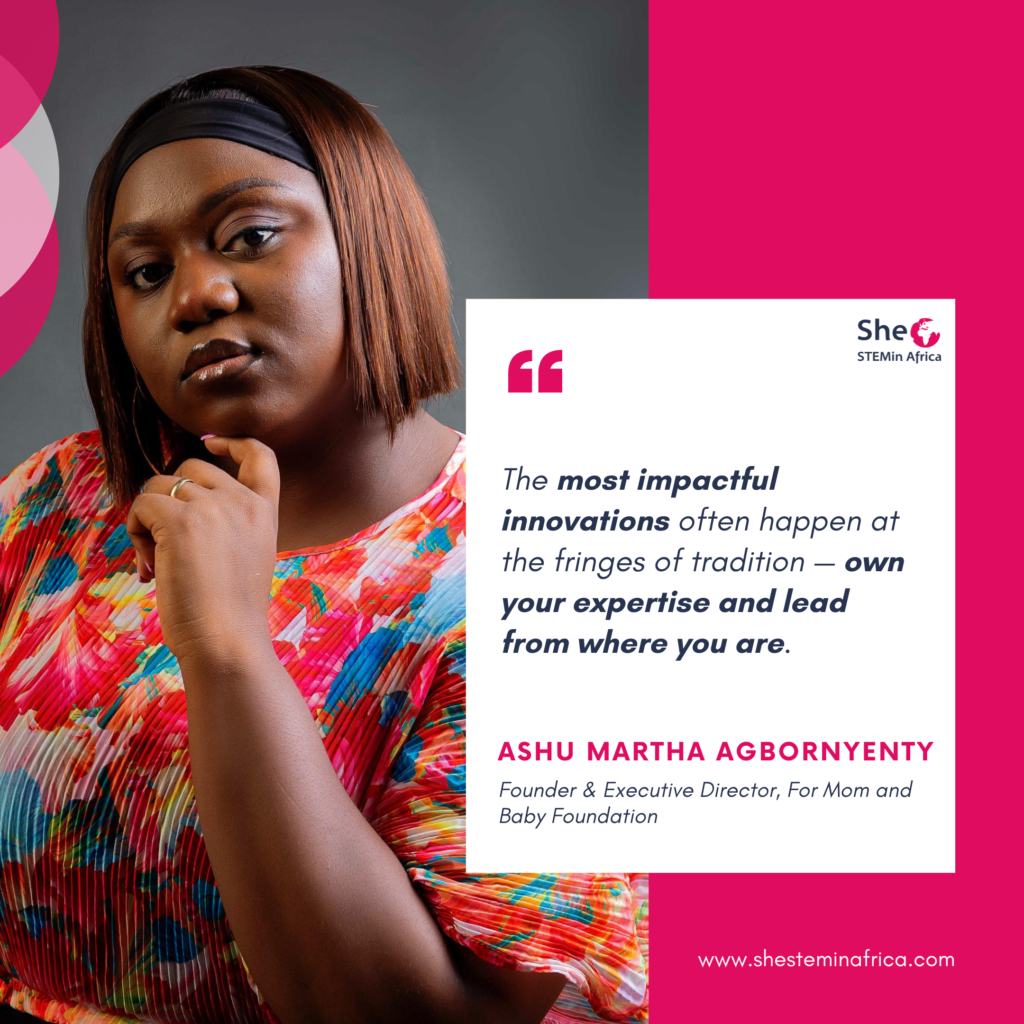
My advice to any young woman considering a career in STEM is to remain steadfast in your passion, even when your chosen path is misunderstood or unpopular. Do not let the lack of external validation diminish your professional identity. When you navigate an unpopular or non-traditional path, you aren’t just a student; you are a pioneer, and that requires a unique kind of resilience. Seek out mentors who see the technical brilliance in what you do, build your own networks when the existing ones feel too narrow, and never be afraid to articulate the scientific complexity of your work. Remember that the most impactful innovations often happen at the fringes of tradition, so own your expertise and lead from where you are.
Vous souhaitez être mis en avant comme Martha Agbornyenty? Rejoignez-nous en cliquant sur le bouton.
Pour rejoindre notre communauté WhatsApp de plus de 350 filles et femmes scientifiques, cliquez ici.
Comment adhérer à notre association ?
– En ligne en cliquant ici
– Par Mobile Money chez à Mafotsing Nguemte Irène – Orange : +237 698 86 69 35 ou MTN : +237 676 48 11 26
Si vous souhaitez faire un don pour soutenir notre travail, nous serions ravis de vous compter parmi nos précieux donateurs.
#InspiringAfricanWomenScientists #WomenInSTEM #STEM #WomenInScience #WomenInSTEM #SheSTEMinAfrica #MidwiferyMatters #MaternalHealth #DigitalMidwifery #WomenInHealth #STEMAfrica #Mentorship #LeadFromWhereYouAre #AfricanWomen #ScienceAndImpact #HealthInnovation #Cameroon #InspiringWomen #STEMLeaders

Publié par Dr. Pulchérie Matsodoum Nguemté
Fondatrice de She STEMin Africa