
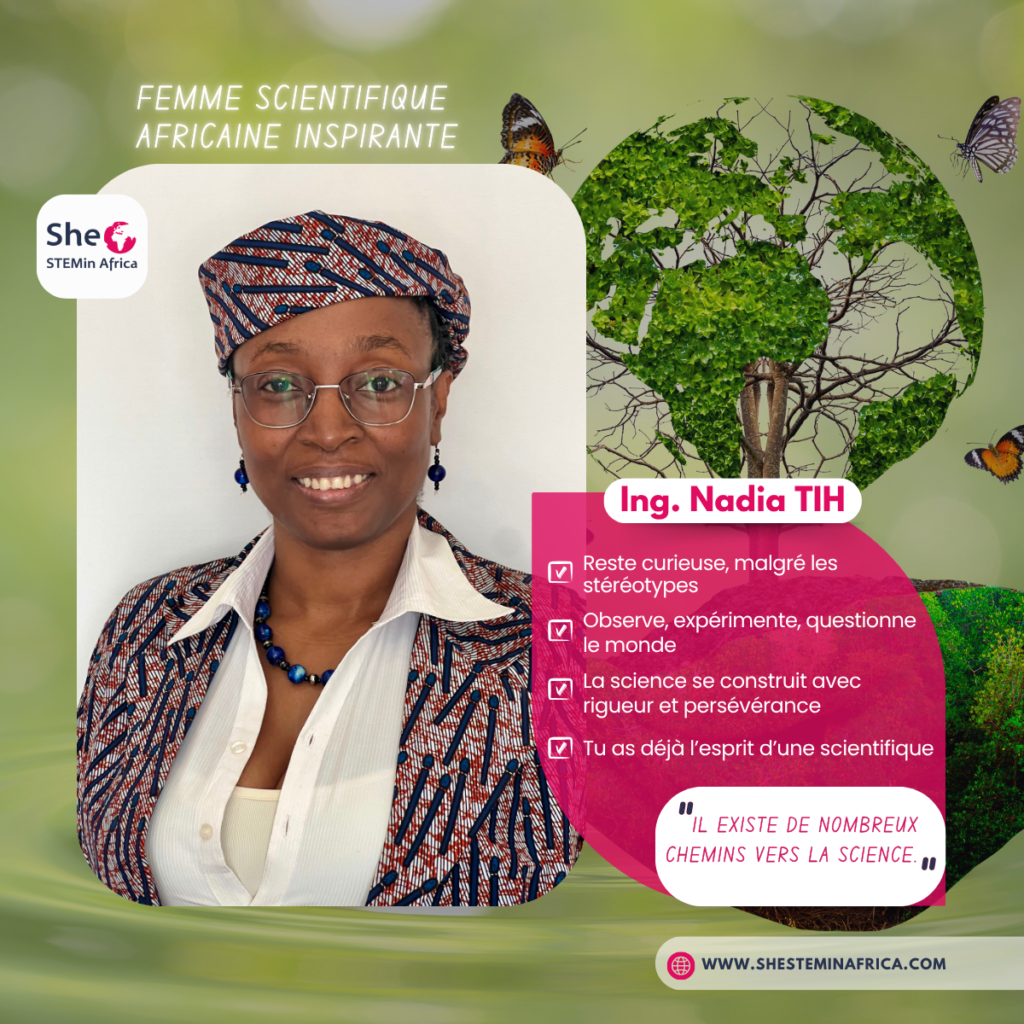
Can you tell us about your academic background in STEM?
My academic background is in environmental engineering, with a strong focus on the systemic analysis of ecosystems.
My work explores how natural systems function as interconnected networks, where biological, climatic and human dynamics interact.
This perspective has led me to approach environmental questions not only through traditional scientific frameworks but also through systems thinking, examining how ecological balance emerges from complex interactions within ecosystems.
What motivated you to pursue a career in this field?
My motivation comes from a deep curiosity about how natural systems maintain balance. Ecosystems are complex networks where biological, climatic and human dynamics interact continuously.
One challenge I often observe is that environmental issues are frequently presented as if they belonged to a separate domain, disconnected from economic, social or political realities. This separation can make environmental questions appear abstract or distant from everyday decision-making.
My work aims to reduce these intellectual and strategic divides. By approaching ecosystems through systems thinking, I try to better understand how natural and human systems interact, so that decisions, whether scientific, political or economic, can be made with a more complete understanding of their long-term consequences.
What challenges have you faced as a woman in STEM and how have you overcome them?
Like many women in STEM, I have sometimes faced environments where scientific confidence was not always equally encouraged or recognized. In many cases, women are subtly directed toward other fields or are not always encouraged to fully explore scientific paths.
One way I have navigated these challenges is by focusing on curiosity, continuous learning, and by building intellectual independence. Science ultimately rewards rigor, persistence, and critical thinking.
I also believe that diversity of perspectives strengthens science itself. Different experiences bring new ways of observing and understanding complex systems.
What are the most exciting developments or projects in your field at the moment?
One of the most exciting developments in my field is the growing recognition that ecosystems must be understood as complex systems. Advances in systems science, ecological modeling, and Earth system research are helping us better understand how large ecosystems function and interact.
Another particularly important area is the increasing attention given to tropical forests such as the Amazon and the Congo Basin. These ecosystems play a crucial role in global climate regulation and planetary balance.
What is especially promising is the emerging dialogue between scientific research and the knowledge systems of indigenous and traditional communities, whose long-standing relationship with these ecosystems offers valuable insights.
How do you see the future of STEM? What are your predictions for the areas that will see significant growth, and what challenges will need to be overcome?
The future of STEM will increasingly depend on our ability to connect disciplines that have traditionally been treated separately. Environmental questions cannot be understood only through ecology, just as economic or technological decisions cannot be separated from the natural systems they depend on.
One of the major challenges for the future will be developing approaches that integrate environmental science, systems thinking, economics and social dynamics in order to support more informed and sustainable decision-making.
What advice would you give to a young woman considering a career in STEM?
My first advice would be to remain curious and not limit yourself based on stereotypes about who belongs in science.
Many young girls are sometimes encouraged to pursue literary fields because the conditions around them do not always support their confidence in scientific disciplines. Yet scientific curiosity can develop in many different ways, through observation, experimentation, and practical engagement with the world.
It is also important to remember that there are many paths into science. While formal education is important, scientific thinking is fundamentally about curiosity, questioning, and the desire to understand how the world works.
If you are fascinated by nature, by systems, by patterns or by how things interact, you already have the mindset of a scientist.
Vous souhaitez être mise en avant comme Ing. Nadia TIH ? Rejoignez-nous en cliquant sur le bouton.
Pour rejoindre notre communauté WhatsApp de 400+ filles et femmes scientifiques, cliquez ici.
Comment adhérer à notre association ? : En ligne en cliquant ici
Si vous souhaitez faire un don pour soutenir notre travail, nous serions ravis de vous compter parmi nos précieux donateurs.
#WomenInSTEM #SheSTEMinAfrica #ExperiCi #FemmesAfricaines #STEMAfrica #EnvironmentalEngineering #SystemsThinking #Ecosystems #CongoBasin #TropicalForests #FemmesScientifiques #InspiringAfricanWomenScientists

Publié par Dr. Pulchérie Matsodoum Nguemté
Fondatrice de She STEMin Africa